राधे राधे Radhe Radhe

Back to the home page

Braj culture

Festivals and stories, one page each

The festivals Vrindavan and Barsana keep, and the stories behind them, as the temples tell them.

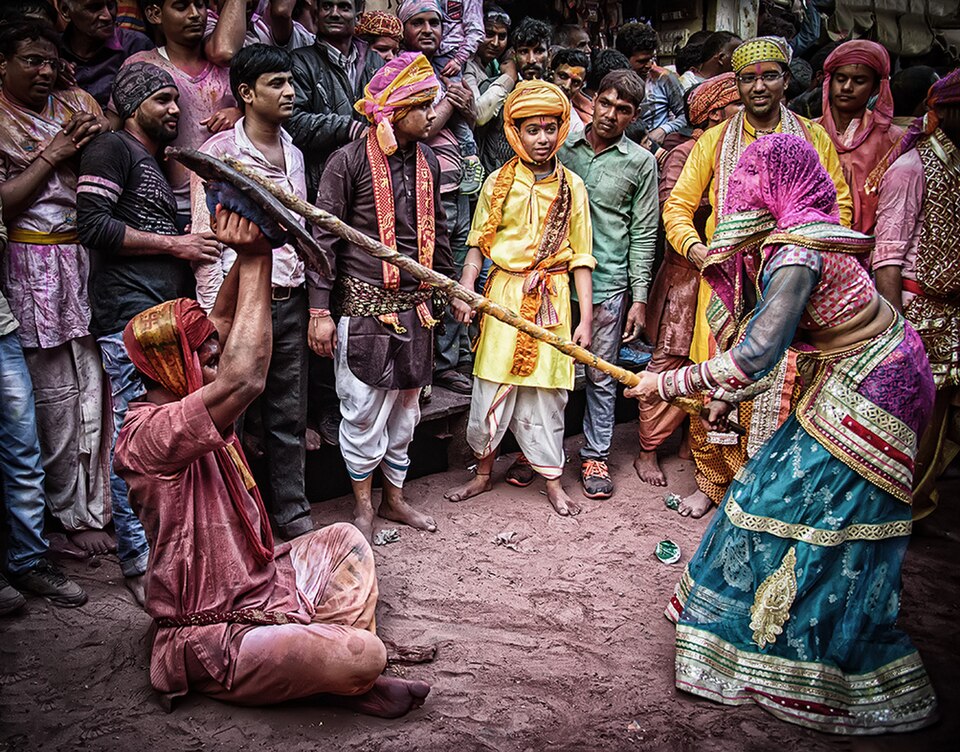
A woman swings a lathi at a shielded man during Lathmar Holi as a crowd watches

Photo: Mondalsaibal, CC BY-SA 4.0, Wikimedia Commons

Culture

Lathmar Holi, Barsana's answer

The district tells the legend: Krishna came to tease Radha and her friends in her village, and Barsana's women chased him off. Men from Nandgaon still visit every spring, and the women still greet them with lathis, in the compound of what the district calls the only temple in the country dedicated to Radha.

Source: District Mathura, Government of Uttar Pradesh

Culture

Bahulastami, the day Radha Kund appeared

ISKCON Vrindavan kept it on 2 November 2026, in the month of Kartik. The temple tells it this way: after the pastime with Aristasura, Krishna manifested Shyama Kund, and Radharani with her sakhis manifested Radha Kund beside it. Devotees come to bathe in the kund, pray, and chant. The temple holds Radha Kund especially dear for how close it stands to Srimati Radharani.

Source: ISKCON Vrindavan, official website

Culture

Govardhan Puja, a hill made of food

ISKCON Vrindavan kept it on 10 November 2026, remembering the day Krishna lifted Govardhan on the little finger of his left hand and held it seven days, sheltering the people of Vraja and their cows from Indra's rain. The temple says he had told them to worship the hill itself, which gave their cows grass and gave them water, fruit and shelter. The day is also kept as Go Puja, for the cows, and as Annakuta, a mountain of food cooked and offered to Krishna.

Source: ISKCON Vrindavan, official website

Culture

How Banke Bihari came out of Nidhivan

Swami Haridas was singing in a kunj of Nidhivan when his disciples were caught in a light they could not stand, and at his asking the Lord came before them in person with his divine consort, smiling, in a playful mood. Haridas asked the two of them to take one form, as cloud and lightning are one thing, and what was left was a single black charming idol. The temple that stands over it now was built in 1862, in the Rajasthani style of its day, with the Goswamis raising the money themselves.

Source: Shri Banke Bihari Mandir, its own history page

Culture

Gopeshwar, the day Shiv came as a gopi

Banke Bihari Mandir tells this one. On Sharad Poornima, Shiv came to the Rasa Mandal and Vrinda Devi turned him away, telling him there is no male in Vrindavan other than Krishna. He sat in meditation, Lalita Devi told him what to do, and he took a dip in the Yamuna and came out a young charming gopi. He was let in, and Krishna called him Gopeshwar. For this the temple holds Shiv to be the foremost Vaishnav and the guru of all Vaishnavas. His temple stands near Vamshivat.

Source: Shri Banke Bihari Mandir, its own page on the legends of Vrindavan

Culture

Radhashtami, when devotees throng Barsana

On Radhashtami 2026, 19 September, devotees thronged the Shri Radha Rani Temple in Barsana, and temples across Mathura, Vrindavan and the wider Braj region, India's state broadcaster reported. Hindu tradition holds that Radha Rani was born in Barsana, and Radhashtami marks her arrival; devotees fast and worship Radha and Krishna, believing it brings love, happiness and peace into their lives.

Source: Akashvani News, All India Radio / Prasar Bharati

Culture

Gopashtami, when Krishna began herding the cows

ISKCON Vrindavan dates it 17 November 2026. The temple tells it as the day Krishna began tending the cows, having looked after the calves before then, as a child. It is also called Gosthashtami, and the temple remembers him that day by two of his names: Govinda, the giver of pleasure to the cows and the senses, and Gopala, their protector. The day is kept with Go Puja, with prayers and thanks, the cows decorated where that is fitting, and fodder and clean water given to them.

Source: ISKCON Vrindavan, official website